There are many ways to make the road to Damascus memorable.
The traditional version involves a blinding light, a conversion and the subsequent transformation of Christianity.
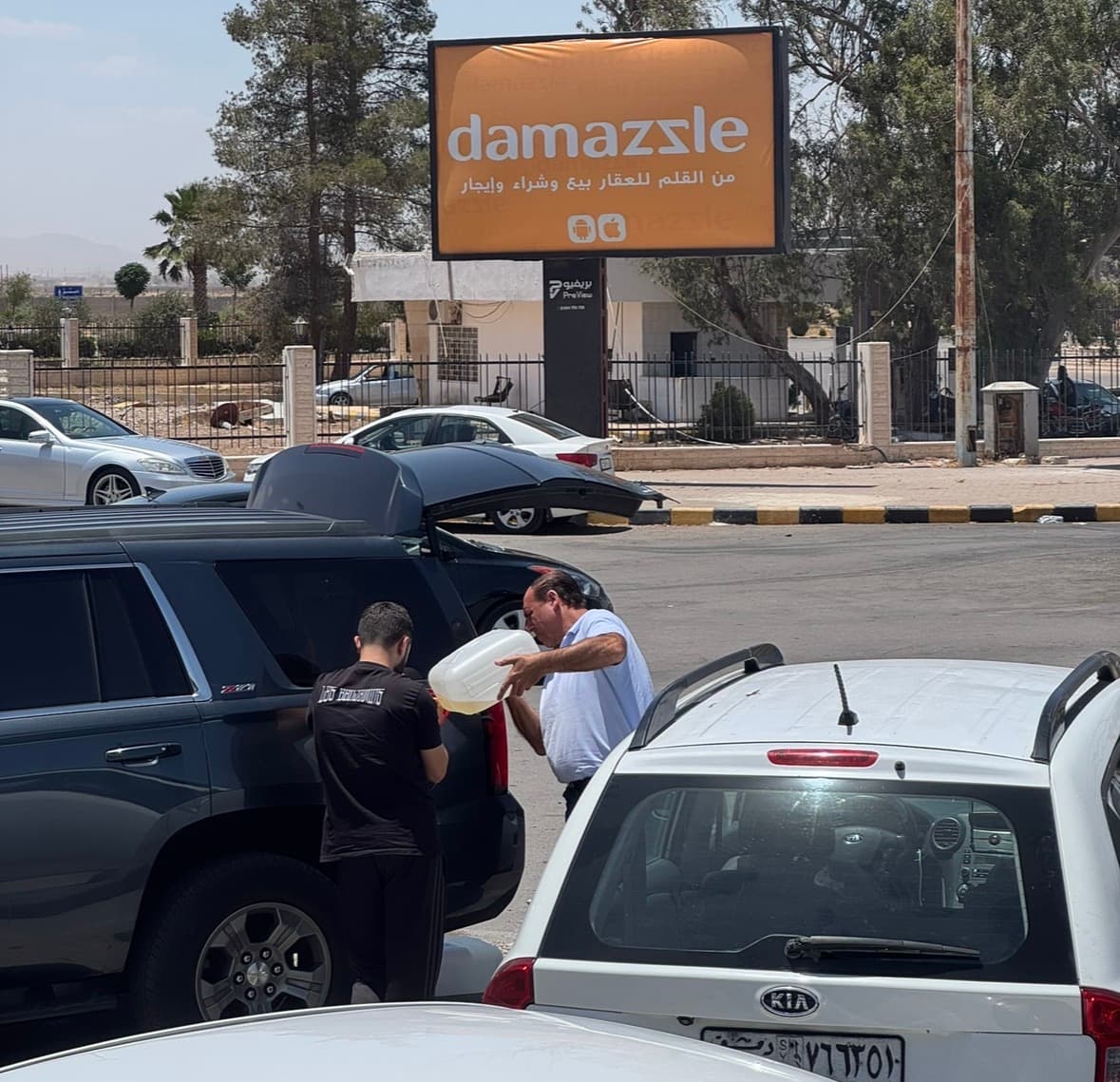
The modern Syrian version involves diesel.
Across Syria this week, people have been discovering just how much of modern life depends on the price of a liquid most of us would prefer never to think about. Diesel has become sharply more expensive. Petrol has followed it upwards. So has gas.
The result has been protests across the country, burning tyres, blocked roads and calls for the dismissal of Energy Minister Mohammed al-Bashir. Reuters described them as the most widespread demonstrations since the fall of Bashar al-Assad.
Parliament has summoned al-Bashir for a hearing on Thursday.
It is difficult to imagine a less enviable appointment.
The immediate cause of the trouble is straightforward. The government raised diesel prices by 40 per cent and petrol by as much as 28 per cent. These are not the sort of increases that disappear discreetly into a household budget.
Fuel has the irritating habit of appearing in the price of almost everything else. This is why arguments about fuel rarely remain arguments about fuel for very long.
In Syria, the problem is particularly acute because the country is poor, its energy infrastructure is badly damaged and a great many households have remarkably little money left over after paying for the necessities of life.
The government has explanations for what has happened.
Quite a lot of them, in fact.
Syria inherited an energy system devastated by more than a decade of war. Domestic production is insufficient to meet demand, so the country depends heavily on imported petroleum products and therefore on international markets behaving themselves.
They have chosen not to.
Regional conflict has pushed petroleum prices higher and disrupted supplies. Reduced Russian exports, tighter refining capacity and higher freight and insurance costs have added to the pressure. Meanwhile, Syria’s Baniyas refinery is undergoing a major overhaul, temporarily increasing the country’s dependence on imported fuel.
If you were designing circumstances in which not to raise the price of diesel, this would be a respectable attempt.
Yet governments cannot indefinitely sell something for less than it costs to obtain, particularly governments without much money.
That is the economic problem.
The political problem is that Syrians do not buy diesel with macroeconomics.
They buy it with wages.
And Syrian wages have spent years becoming alarmingly small in relation to almost everything they are supposed to purchase.
This is where the fuel protests become more interesting than a dispute over the price displayed on a petrol pump.
Since the fall of Bashar al-Assad, discussion of Syria’s economy has tended to happen at a rather grand altitude.
There are reconstruction agreements, investment conferences, electricity interconnectors, mining projects, financial reforms and plans to reconnect Syria with international markets. Sanctions have been dismantled. Foreign delegations have arrived. Governments and companies that once avoided Damascus are again discussing what might be built there.
These developments matter enormously.
Unfortunately, you cannot put an investment memorandum in a fuel tank.
For ordinary Syrians, economic recovery happens much closer to the ground.
Can I afford the bus?
How much will bread cost next week?
Can I run the generator?
Can I afford to drive to work?
These questions rarely feature prominently at investment conferences. They nevertheless have an inconvenient habit of determining whether people believe an economy is actually improving.
That helps explain why the protests have acquired a political dimension so quickly.
Demonstrators have demanded al-Bashir’s dismissal. Others have questioned government spending while Syrians are being asked to endure further austerity.
This is hardly a uniquely Syrian difficulty. Governments throughout history have discovered that asking the public to economise works rather better when the government looks as though it has received the same memo.
In Syria, however, the contrast is particularly sharp.
Much of the population has endured years of inflation, collapsing purchasing power, electricity shortages and deteriorating public services. The new government did not create most of those problems.
It did inherit them.
Eventually, inherited problems simply become problems.
That is what makes Thursday’s parliamentary hearing interesting.
Al-Bashir will have to explain not simply why fuel became more expensive, but what the government intends to do about it. Parliament, meanwhile, has an opportunity to demonstrate whether it can turn public anger into something more consequential than an exchange of speeches. The Assembly says the hearing will examine the reasons for the increases and the considerations behind the pricing decision.
For Syria, that is not an entirely ordinary development.
For decades, meaningful parliamentary scrutiny of ministers was hardly a celebrated feature of political life. A minister being summoned because citizens are furious about the price of diesel therefore carries significance beyond the price of diesel itself.
The important question is what happens afterwards.
The government’s longer-term answer is sensible enough: increase domestic oil production, rehabilitate wells and fields, restore refining capacity and reduce dependence on imports. Baniyas itself is undergoing work intended to raise processing capacity from around 80,000 to 130,000 barrels a day.
Governments rebuild countries in years and decades. People experience economies by the day.
A power station may take years to rehabilitate. An oilfield requires investment. A refinery overhaul takes months.
A litre of diesel is needed this morning.
That difference in timescale is easy to overlook when reconstruction is discussed in billions of dollars and five-year programmes.
There is another uncomfortable problem beneath the demonstrations: the government has very few painless options.
It can subsidise fuel, placing more of the burden on public finances already required to rebuild almost everything. Or it can allow prices to follow international markets, which transfers more of the burden to households and businesses that are hardly overflowing with money themselves.
Neither option has much to recommend it.
Syria is poor. Its infrastructure requires enormous investment. Its population has already endured an extraordinary decline in living standards. The government has limited resources, while international energy markets have chosen a spectacularly inconvenient moment to become more expensive.
The argument on Syrian streets is therefore not really about whether somebody must pay.
It is about who.
That is why these protests deserve attention beyond the immediate dispute over fuel prices. They are an early encounter between the enormous promises of post-Assad reconstruction and the considerably less glamorous arithmetic required to pay for it.
The road to Damascus may eventually be lined with new power stations, factories, businesses and investment.
For the moment, people are mostly wondering how much it will cost to drive down it.